Are you planning to go to South Korea, but you don't know which transport options are best? Or are you looking to determine your transport budget to plan your future trip to the land of calm mornings?
In this article, I am going to detail you through a comprehensive guide on how to get around in South Korea!
You will understand why it is so easy to cross Korean lands with public transport, why it is not necessary to rent a car on site, my best advice to optimize your trips through my tips and the mistakes to avoid once there.
Before arriving in South Korea: everything you need to know about transport
First and foremost, it's important to understand why South Korea has one of the best transport networks in the world, and why it's often much easier to take a train, bus, or taxi than elsewhere.
I will explain to you why Google Maps is not preferred for transport in South Korea, and what are the alternatives.
Then I will give you some advice on which applications to download on your smartphone to make your trips much more serene.
Why is transport in South Korea so efficient?
In my opinion, transportation in South Korea is among the best in terms of efficiency, punctuality and cleanliness for several reasons:
- Effectiveness : The frequency with which subways, trains and buses pass is quite frequent, which allows you to really optimize your trips.
- Punctuality : the transport schedule is respected, with a very low delay rate.
- Cleanliness : Whether it is the stations or the interior of transport, cleanliness is a priority for the well-being of passengers.
To this end, the transport network within the country covers practically all the territory by combining the various public transport available:
- Subway : There are 6 subway networks established in South Korea (the cities of Seoul, Incheon, Busan, Daejeon, Daegu and Gwangju)
- Train : As in France, South Korea has its own fast trains (KTX, SRT), and regional trains that cover specific areas
- Bus : There are urban buses (travel within the city) and interurban buses (travel between cities) which alone cover almost all of South Korea
- Taxi : There are a lot of taxis in South Korea. It is relatively easy to find them, especially thanks to their own Kakao T mobile application.
It is possible to combine several of these types of transport to get to different places, which is really practical, especially if you want to go off the beaten path.
With such a network, the question of renting a car in South Korea arises.
My opinion: I've tested almost every form of public transport, and to put it mildly, South Korea has such an efficient network that I've never had the need to rent a car. Tell you that I was able to do the whole tour of South Korea in 3 weeks by combining bus-train-subway only.
Why does Google Maps not work well in South Korea for transport?
I want to make it clear that Google Maps works well in South Korea. Having used it several times there, the application has helped me a lot in some situations, especially to find great restaurants and also to guide me.
But it turns out that the country has developed its own navigation application itself: Kakao Map.
By using this application, the information will be much more reliable because you will have real-time access to the passage of transport. It optimizes your connections and seeks the fastest solution to allow you to reach your destination in less time.
My opinion: I recommend having both applications on your smartphone just in case. Because Naver Maps is mostly used by the Korean population, and some places or stations are written in Korean, unlike Google Maps.
The applications to download before setting foot in South Korea
Here are the essential applications to download on your smartphone before you leave for South Korea:
- Kakao Map : essential for navigating the country and keeping track of transport times in real time
- Papago : an equivalent to Google Translate, but with much better translation accuracy. In particular, it allows you to translate the signs in the streets, or to help you be understood if you want to find your way around.
- Korail App : an application that allows you to book your KTX train tickets in advance (fast train)
- Klook : an equivalent of Get Your Guide, but dedicated to activities in Asia. It allows you to be able to Book some intercity buses in South Korea, Korail Pass, and also buy your AREX ticket (train that connects the airport and Seoul).
My opinion: Personally, I used Kakao Map a lot to navigate South Korea. I also used Papago to be able to express myself in Korean with the few basics that I learned. Google Maps especially helped me find restaurants.
💳 T-Money: the essential card to have at the airport
In this section, I am going to tell you about an essential card to have during your entire trip to South Korea: The T-Money.
Let me explain to you:
- The principle of T-Money and how will it make your life easier in all your trips, and thus in everyday life.
- Where can you get it, how to use it and how to charge it
- How T-Money is advantageous compared to other cards, with a detailed table of the specificities of each
What is T-Money and why should you get one immediately?
In South Korea, there is a card that is accessible to anyone at a lower price, and that allows you to do a lot of things with:
- Be able to pay for your groceries in convenience stores (CU, 7 Eleven, GS25, Family Mart)
- Use it as a transport card to travel by subway, city buses, sometimes even some taxis all over the country
In short, it acts as both a bank card and a transport card. It is a very practical card for a traveller who is traveling to South Korea for the first time. Because you will not need to take out your bank card or hope to buy your transport tickets or groceries.
In the context of transport, T-Money is used in the following way:
- In a subway : On each gate, you will find a card reader designed to validate your entry into the station. Once you have arrived at your final destination, you will have to put your T-Money back in front of the reader to validate your exit from the subway.
- In a city bus : Get on the bus, then place the T-Money in front of the card reader to validate the climb. To get out of the bus, you will have to take the back door provided for passenger exits. You will find another card reader where you will have to go through the T-Money again to validate your exit.
Where can I buy T-Money and how do I top it up?
Getting T-Money is very easy, because you have several points of sale that offer it:
- Convenience stores offer this self-service card at the counter. If not, ask the staff directly.
- The vending machines in the metro stations also offer you the card
Once you have T-Money, you will then need to top it up with cash. Because the card alone is useless. To do this, you will have to go to either:
- Directly in a convenience store. Ask the staff to charge it for you. Tell him the amount you want to top up.
- In an automatic terminal at a metro station. Choose at the terminal that you want to top up the T-Money, then choose the desired amount.
My opinion: As soon as you arrive at Incheon Airport, I invite you to go directly to a convenience store to buy it directly. Recharge the card with cash and you're ready to start your first few days in South Korea on the right foot!
T-Money vs other cards: which one to choose?
For tourists, know that there is more than just T-Money to use as a transport card. There is also a pass that allows you to travel almost unlimited in Seoul (within the limit of 20 trips/day): the Mpass.
Card user ideal price for where to buy? T-Money StandardSubway, bus, taxi, convenience stores~2,500 KRWAll staysConvenience store, vending machine at a MetromPass station (1-7 days) Up to 20 trips/day in Seoul15,000 — 64,500 KRWShort and intense stay in Seoult-money Town in front of Seoul Station (1st floor of Seoul City Tower, 110 Huam-ro, Jung-gu, Seoul
The Mpass offers several rates depending on the number of days you choose to visit Seoul:
- 1 day (15,000 won)
- 2 days (23,000 won)
- 3 days (30,500 won)
- 5 days (47,500 won)
- 7 days (64,500 won)
T-Money remains essential to facilitate your payments in convenience stores. To this end, you can complete it with other cards/passes that give you unlimited access to transport, such as the Mpass.
My opinion : Is Mpass worth it? You have to do the math: the unit price to travel around Seoul (bus or subway) costs an average of 1550 won. You should use public transport at least 10 times to make your pass profitable. If not, just take T-money. In particular, I recommend Stay 3 to 4 days in the capital Which in my opinion is the perfect number of days to visit the highlights.
🚇 The subway: the king mode of transport in the city
The 6 cities with a metro network
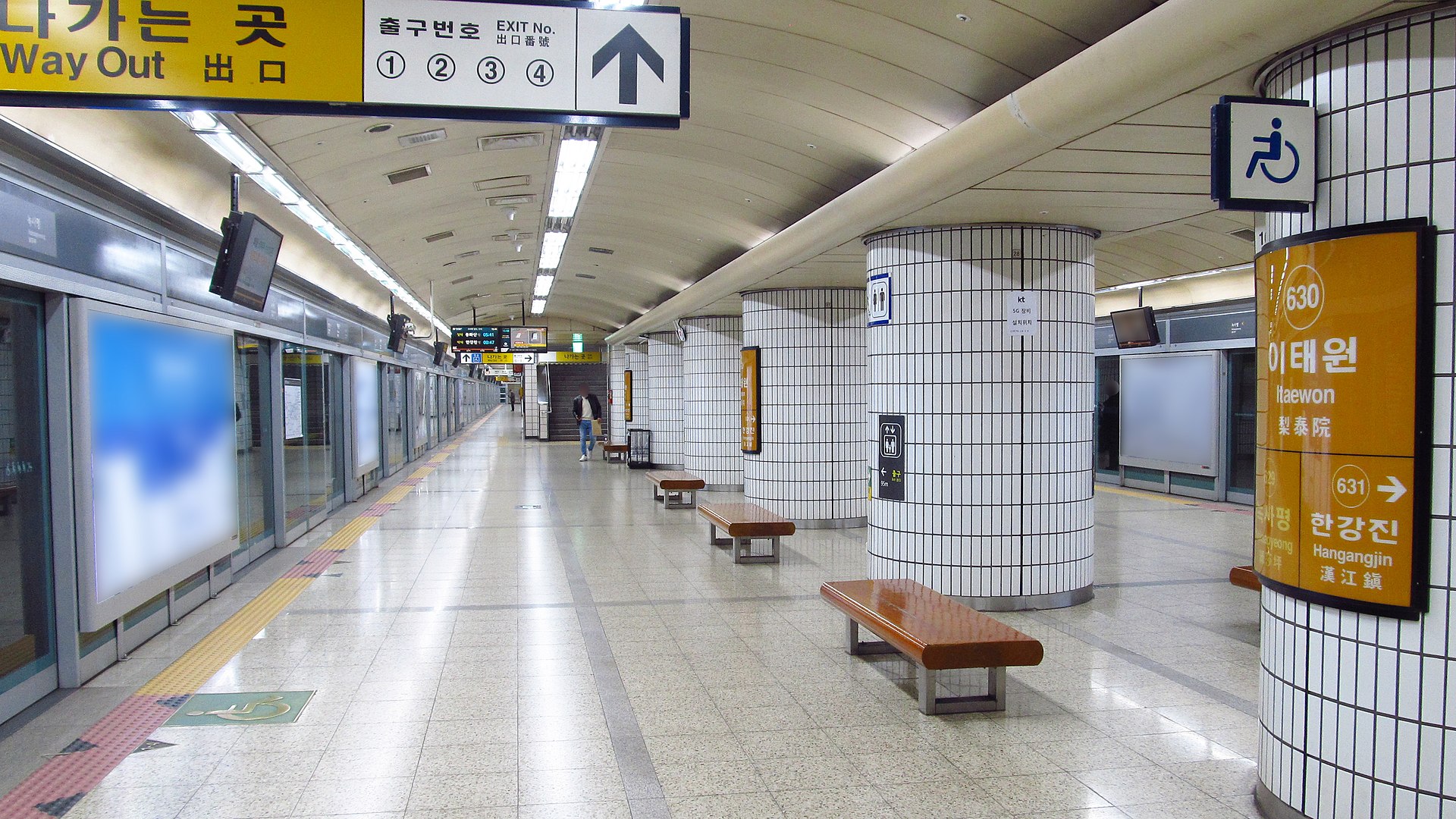
There are 6 subway systems in Korea, the main of which is in Seoul. If you plan to travel across the country, you should know that you also have other cities with a network including:
- Incheon, a city near Seoul where the international airport is located, has 2 lines in total.
- Busan, the second largest city in South Korea with 4 lines in total
- Daegu, a city located not far from Busan, has 3 lines in total
- Daejeon, a city located in the Center-West, has only 1 line in total
- Gwangju, a city located in the southwest, also has 1 single line in total
How do I read the subway map in South Korea?
The first time you go to South Korea, you will surely have a hard time getting used to the various subway line networks. This is completely normal, but you will see that it is really easier than you imagined!
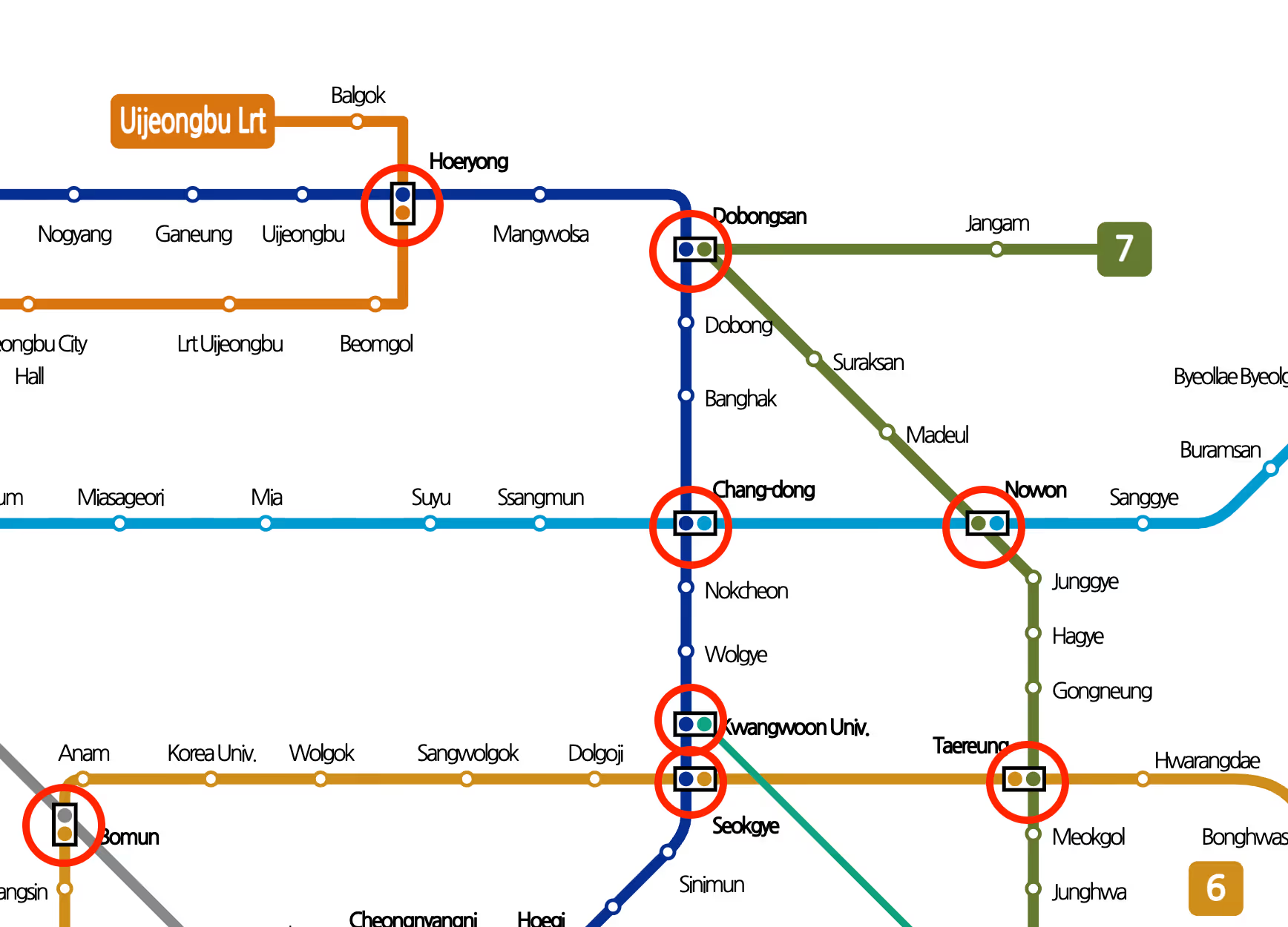
The red circles represent stations where you can make a change to another subway line.
When you read a subway map in each city where the network is present, you will see the same principle for subway line changes: a black box with two or more colored dots to indicate the possibility of changing lines.
Then, to know in which direction to take the subway to a specific destination, I recommend that you download the Kakao Map application if you have not already done so. Indicate your position and then your final destination, and the application will take care of giving you the fastest way with all the details on the line changes to make!
Example: From the map above, I want to go from Jangam (khaki green line) to Suyu (sky blue line). With the Kakao Map application, here is the recommendation:
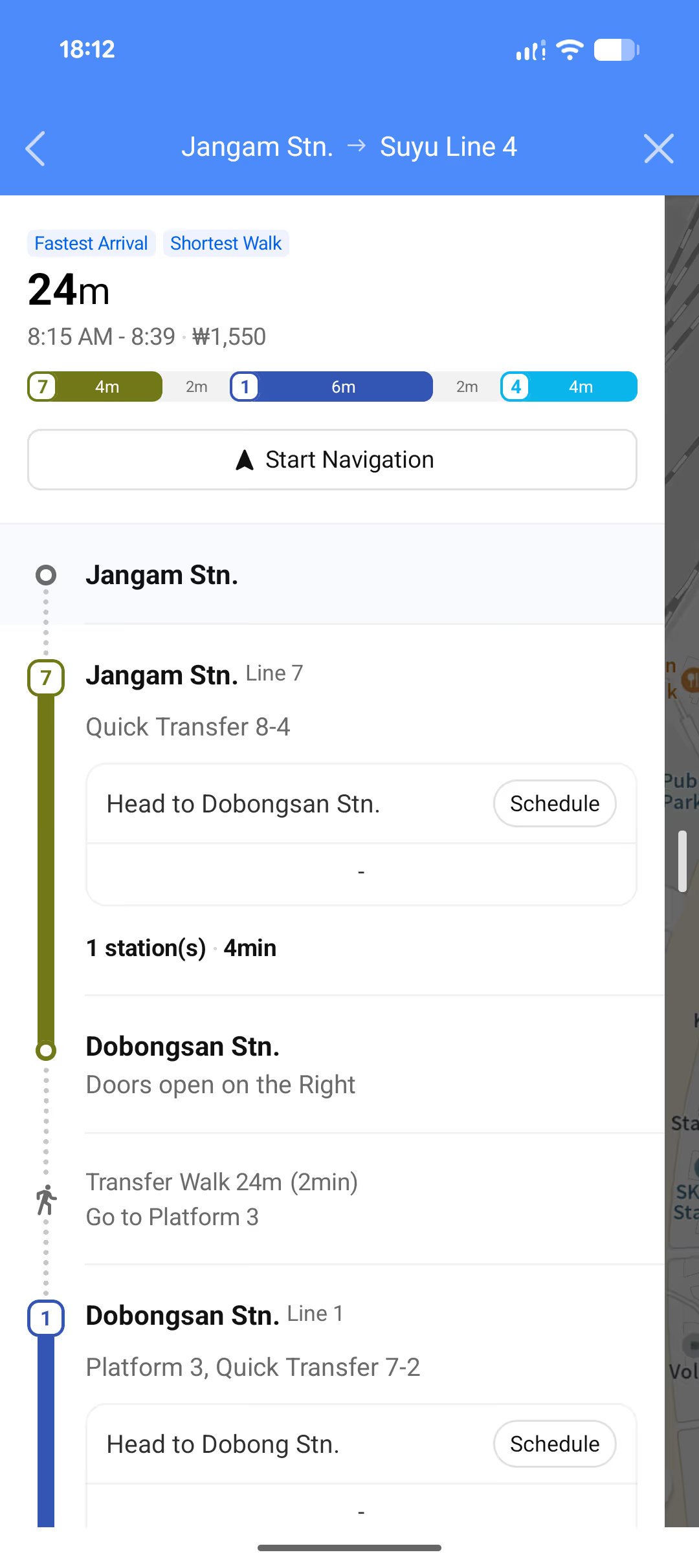
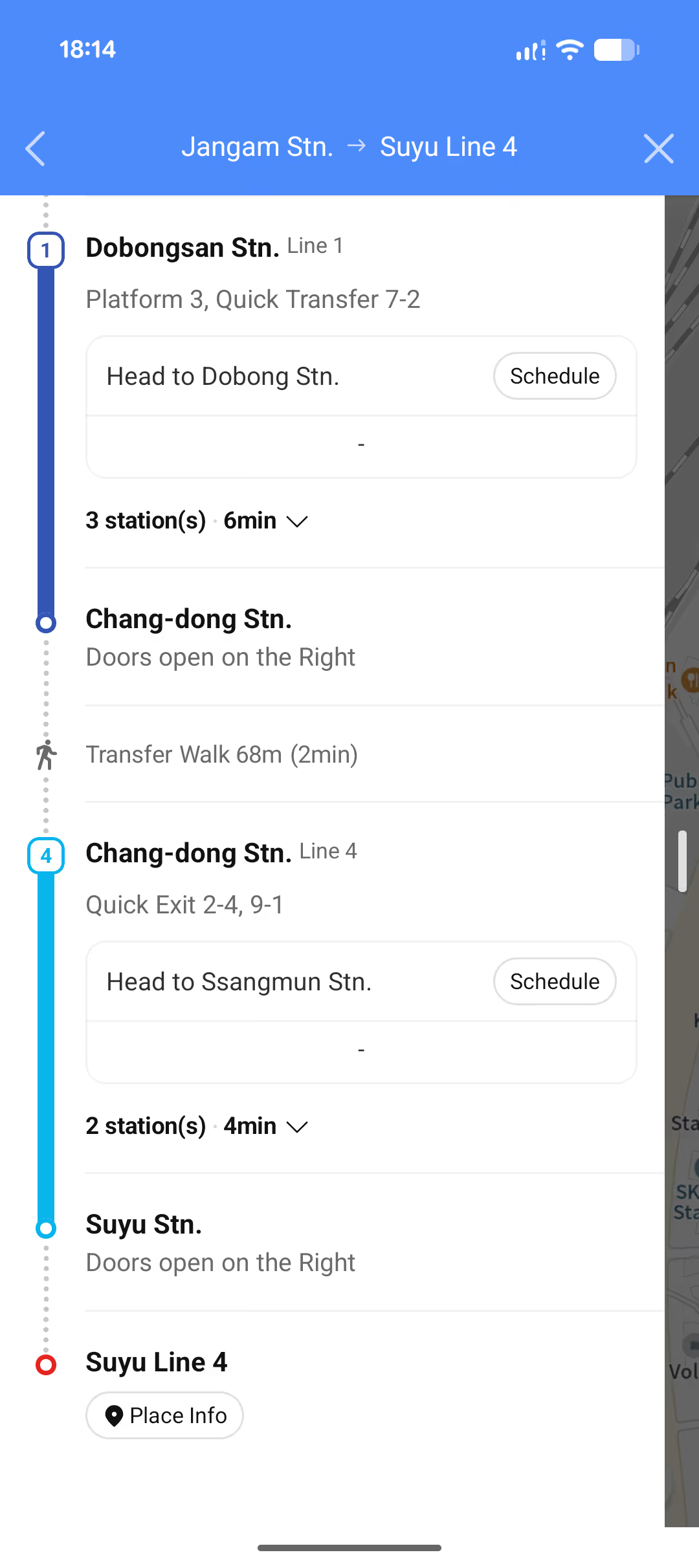
So Kakao Map shows me the following steps:
- Take line 7 at Jangam Station, then get off at 1 station at Dobongan Station
- Change correspondence by walking 2 minutes to platform 3
- Take line 1 at Dobongsan Station, then get off at 3 stops at Chang-dong Station
- Change correspondence by walking 2 minutes to line 4
- Take line 4 at Chang-dong Station, then get off at 2 stations at Suyu Station
So you will reach your destination in 24 minutes, and you will pay a total of 1550 won.
My opinion: Kakao Map will be your best friend everywhere you go in South Korea. Download as soon as possible to get the best itineraries and save you time during your visits!
How do I pay for the subway in South Korea?
Pricing is based on the distance traveled. In Seoul, for example, this is how to account for transport costs:
- The first 10 km cost 1550 won
- Between 10 km and 50 km, you have to add 100 won every 5 km
- Beyond 50 km, 100 won must be added every 8 km
My opinion: Do not worry about distances, because the calculation will be done automatically between your departure and arrival station if you use the T-Money card (a real advantage to avoid headaches).
At each metro station, you will find smart gates to validate your ticket.

At the top of each of the gantries, you will find a space provided for transport cards. This is the blue zone.
Simply stick your card on top. If you hear a small beep, it means you can go through the gantry.
Once you get to your final station, you will have to do the same thing again. This allows the gates to calculate the total distance you have traveled, and deduct the amount from your T-Money card.
My opinion: I invite you to check your balance on your T-Money card from time to time from the automatic terminals. If in doubt, refill it with cash.
🚌 Buses: practical but to be tamed
In the vast majority of cases, the subway is sufficient in itself to be able to move quickly within a city.
But sometimes, some places are not always served by subways, and in this case, the bus is the preferred solution.
In South Korea, the bus network is well established, both in the heart of a city and between cities.
For an itinerary of 15 days to 1 month for example, it would be a shame to limit yourself to only some of the most famous cities, when there are many other fantastic places to visit, including Sokcho, Gangneung, Suncheon or Pohang.
For the first time in the land of quiet mornings, you are surely wondering if the bus is a reliable and comfortable transport? My answer is yes, and I will tell you why!
Why can buses in South Korea be scary at first?

You should know that, basically, buses are intended for locals to get around more easily. To tell you that it is even the preferred mode of transport for an immersion in the daily life of Korean men and women!
Unlike subways where all signs are displayed in foreign languages, this is not necessarily the case for buses.
Another point that can be scary at first when taking the city bus for the first time is The on-board payment system.
I am clearly explaining to you how to do it:
- Get your T-Money card
- Next to the bus driver, you will find a card reader. Simply place the T-Money card in front of it. You will hear a small sound that indicates that you have validated your ticket
- When you get to your station, you will need to go down to the central door. You are going to find another card reader. Pass the T-Money card to validate your exit
- Your T-Money card will be automatically charged according to the distance traveled
With this in mind, you will no longer have any trouble managing to take the city bus!
My opinion: To travel by bus, always have Kakao Map open next to you to see your position in real time. This is in order not to miss your arrival station! This will make it much easier for you to find your next station without needing to know how to read Korean to find your way around.
Interurban express buses (, Kobus)
For me, intercity express buses are the best modes of transport, along with the subway and the city bus. By themselves, you will practically cover the whole of South Korea. So you will hardly need the train to tell you which is more expensive in general.
So here's what you need to know about intercity express buses:
- A solution to travel throughout South Korea at a very affordable price
- The chairs are very comfortable and can be reclined to allow you to sleep
- The frequency of the buses is high, which allows you to leave almost whenever you want during the day to another city.
- For long trips, the bus makes a temporary stop in the rest areas to allow you to go to the bathroom, and take food and drink in the process in small convenience stores.
- You can take intercity express buses directly to Incheon International Airport from virtually any city in South Korea. This is convenient for people who don't necessarily want to go back to Seoul for their return flight.
My opinion: For my bus trips, I used Google Maps, which was clearly my favorite choice to find the best intercity bus routes. By only indicating the cities, the application managed to find me which bus stations to choose, as well as when the bus arrived. Take the test, you'll see!
🚄 The train in South Korea: Fast and comfortable for a reasonable price
Taking a train in South Korea is the most efficient and fastest way to get to more distant cities.
One of the flagship trips made by tourists who come to the country is Seoul - Busan by KTX train (equivalent to TGV in France) for a period of 2 hours to 2.5 hours.
There are many reasons for wanting to choose the train rather than the bus, for example:
- The prices are sometimes equivalent between the two means of transport. For reasons of optimizing time, the train is preferred.
- The train is very punctual with almost no delays.
- Comfort on a train is much better than the bus
- It is easier to book your train ticket in advance online than a bus ticket.
To know the different routes you can do with the train, here is the official map below.
KTX and SRT: the Korean fast train
It is the fastest train in South Korea, but also the most expensive mode of transport. For a trip from Seoul to Busan, it costs 59,000 won one way.
KTX and SRT have two lines that connect major cities including Daejeon, Daegu, Gyeongju, Busan, and Gwangju.
The thick blue (Gyeongbu HSR), red (Honam ISR), and purple (Suseo - Pyeongtaek HSR) lines are where the KTX and SRT operate the routes.
The difference between KTX and SRT is that they are two separate Korean companies, with KTX being the best known to tourists with the possibility of using the Korail Pass for an unlimited trip with the company. On the other hand, although SRT is less well known, it is still interesting because it is cheaper than its competitor if you do not take the Korail Pass.
Semi-fast trains: discover lesser-known cities in South Korea
In the category just below fast trains, you have the option of boarding semi-fast trains to travel to cities that are less well known by tourists.
This is the case, for example, if you want to discover Andong, Gangneung, Gangneung, Suncheon or Pohang, which are very interesting to visit to get off the beaten track.
Prices vary and depend on the distance travelled. In general, you have to count around €30 to €40 per one-way ticket.
To take these trains, you have the choice between 4 lines:
- The dark green line (Jungang) to go to Andong
- The clear purple line (Donghae) to cross the entire East Coast and visit Gangneung or Pohang
- The orange line (Jeolla) to make a crossing in the city of Suncheon
- The brown line (Jungbunaeryuk) to discover the mountainous areas in the center of the country
Classic trains: traveling slowly in South Korea at a reduced price
Classic trains serve both major cities (Seoul, Busan) and lesser-known cities in South Korea. It is a very good alternative to travel slowly and enjoy the landscapes!
Do not miss cities like Suwon, Jeonju or Suncheon, which are essential to visit.
The prices for a classic train trip are between 15 and 30€ depending on the distance. It is therefore a good deal and more economical, although slower than semi-fast trains.
Here are the main classic train lines that I recommend for a trip to South Korea:
- The orange line (Jeolla) to make a crossing in the city of Jeonju and Suncheon
- The dark blue line (Gyeongbu) to visit Suwon City, Daejeon, Daegu and Busan
🛳️ Travel between islands by ferry on Jeju Island and Ulleung
The ferry is surely a means of travel that few tourists consider, and yet well available in South Korea.
In particular, it is possible to take the ferry from the city of Mokpo to go to Jeju Island. The one-way ticket costs 26,000 won, which is really cheap compared to flying.
Another island that exists and that very few people know about is Ulleung Island. Located in the East, it is an island renowned for its magnificent landscape and its multitude of hiking trails. The only way to get there is by ferry.
💡 Transport budget summary
Means of transport Journey/usageIndicative priceNotesT-MoneyPurchase of the card~2,500 KRW (~€1.70) Without initial credit, to be recharged in cashSubway0 — 10 km (e.g. Seoul) 1,550 KRW (~€1.10) +100 KRW/5 km up to 50 kmUrban busCity trip~1,550 KRW (~1.10 €) Distance pricing, same logic as the subwayMpassUp to 20 trips/day in Seoul15,000 — 64,500 KRW (11 — 64,500 KRW (11 — 47€) 1 to 7 days — profitable from 10 trips/dayIntercity express busBetween cities (e.g. Seoul → Busan) Cheaper than the trainComfortable, very good national coverageKTX/SRT trainSeoul → Busan (2h15—2h30) ~59,000 KRW (~43€) The fastest, SRT slightly cheaper than KTXSemi-rapid trainLesser known cities (Andong, Gangneung, Pohang...) ~30,000 — 55,000 KRW (22 — 40€) Good speed/price compromiseClassic train (Mugunghwa)Big cities + secondary cities (Suwon, Jeonju...) ~20,000 — 41,000 KRW (15 — 30€) The slowest but the most economicalKorail PassUnlimited trains (KTX included) over 2 to 5 days Starting from ~121,000 KRW (~€88) For foreign tourists only, SRT not includedAREX ExpressIncheon Airport → Seoul Station (40—45 min) ~8,700 — 9,500 KRW (~6 — 7€) Reserved seat, WiFi, luggageAREX ClassicIncheon Airport → Seoul Station (~60 min) ~4,800 KRW (~3,50 €) Slower, multiple stopsAirport limousine busIncheon → neighborhoods/hotels~15,000 — 18,000 KRW (11 — 13€) Convenient with heavy luggageTaxiIncheon → Seoul Center~60,000 — 80,000 KRW (44 — 80,000 KRW (44 — 58€) Nocturnal supplement (midnight — 4 am)FerryMokpo → Jeju ~ 26,000 KRW (~19 €) one way Cheap alternative to flying